
An alternate run line is a modified version of the standard MLB run spread, letting you choose a margin of victory different from the fixed +/−1.5 runs that sportsbooks post by default. The standard industry term is "alternate spread," and in baseball it applies specifically to run totals. Understanding the alternate run line meaning gives you access to a betting tool that most casual bettors never use, but that sharp bettors rely on to extract value from specific matchups. Probettorsports breaks down exactly how these lines work, when to use them, and what they cost you in odds.
What is the alternate run line meaning in baseball betting?
The standard MLB run line is always set at +/−1.5 runs, making it one of the most consistent betting markets across all sportsbooks. A favorite at −1.5 must win by 2 or more runs to cover. An underdog at +1.5 covers if it wins outright or loses by exactly 1 run.
Baseball's low scoring is the reason the run line stays fixed at 1.5. Unlike football or basketball, where spreads shift based on team strength, MLB sportsbooks keep the spread constant and adjust the price instead. A heavy favorite might be −1.5 at −180, meaning you risk $180 to win $100. A big underdog might be +1.5 at +160, paying $160 on a $100 bet.

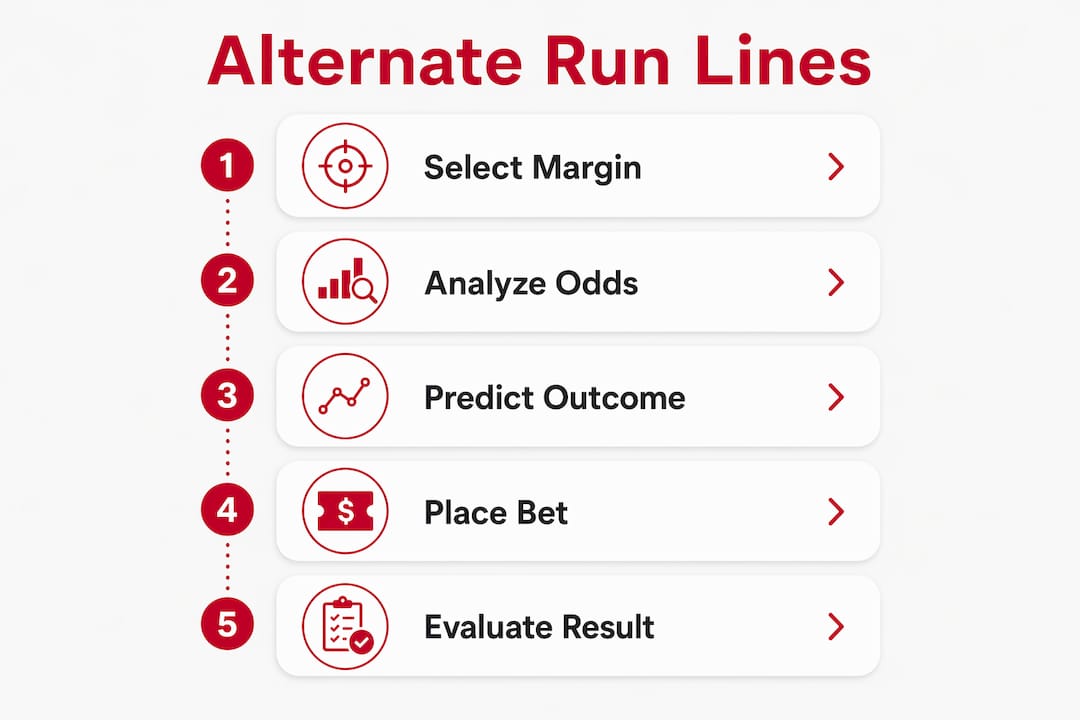
The alternate run line changes that fixed spread. You can move it to −2.5, −3.5, or even −4.5 for a favorite, or to +2.5 and beyond for an underdog. Each shift changes the odds to reflect the new probability demand. Moving a favorite from −1.5 to −2.5 makes the bet harder to win, so the payout goes up. Moving an underdog from +1.5 to +2.5 makes the bet easier to win, so the payout drops.
Here is what the run line options typically look like across a game:
- −0.5 (moneyline proxy): The favorite must simply win. Odds are close to the moneyline price.
- −1.5 (standard): Favorite wins by 2+. The default run line bet.
- −2.5: Favorite wins by 3+. Requires a clear blowout.
- −3.5 and beyond: Reserved for dominant matchup forecasts. Odds shift sharply.
- +2.5 (underdog): The underdog can lose by up to 2 and still cover.
Pro Tip: If you want to bet a heavy favorite but hate the juice on the moneyline, the −1.5 run line often gives you a better payout at the cost of needing one extra run. That tradeoff is worth calculating before every MLB bet.
Why do sportsbooks offer alternate run lines?
Alternate run lines include spreads ranging from −0.5 all the way to −4.5 for favorites, with matching positive lines for underdogs. Sportsbooks offer them for two reasons: to attract sharp bettors and to generate more betting volume on a single game.
Sharp bettors use alternate lines to express a specific margin prediction. If a bettor believes the Yankees will beat a weak rotation by 4 runs, the standard −1.5 line does not capture that conviction. The −3.5 line does, and it pays better. Sportsbooks price these lines to profit regardless of outcome, but they also know that offering more options keeps high-volume bettors engaged.
- Attract sharp action: Advanced bettors want to bet margins, not just winners. Alternate lines give them that option.
- Diversify the market: More line options mean more bets on the same game, increasing book revenue.
- Accommodate parlay builders: Bettors building parlays often use +2.5 underdog lines as safer legs than straight moneylines.
- Reflect specific game contexts: A pitcher's duel calls for tighter lines. A blowout matchup invites wider spread betting.
Market availability of alternate run lines varies by sportsbook. Major contests typically have deeper alternate line menus than smaller regional games. That variation affects your strategy directly, since you cannot always find the exact spread you want on every game.
How do alternate run lines change your betting strategy?
Choosing an alternate run line forces you to predict margin of victory, not just the winner. That is a fundamentally different analytical task. One-run games make up about 30% of MLB outcomes, which means the jump from −1.5 to −2.5 eliminates a huge portion of winning scenarios for the favorite. That one-run difference is far more significant than it looks on paper.
The odds shift reflects this reality. A team that covers −1.5 roughly 55% of the time might cover −2.5 only 38% of the time. The payout improves, but the probability drops sharply. You need a genuine edge in your matchup analysis to make −2.5 or deeper lines profitable over time.
Alternate run line markets often carry higher bookmaker margins than standard lines. Sportsbooks know these bets attract sharp, conviction-driven action, so they build in extra vig to protect their position. That means you are paying more for the privilege of betting a specific margin, which raises your break-even win rate.
Here are the key strategic considerations before placing an alternate run line bet:
- Pitching matchup: An ace facing a weak rotation is the clearest signal for a wider favorite spread.
- Bullpen depth: Late-inning leads evaporate with a shaky bullpen. A team with a strong closer holds margins better.
- Offensive firepower: High-scoring lineups against below-average pitching create blowout conditions.
- Weather and ballpark: Wind blowing out at Wrigley Field inflates scoring. Pitcher-friendly parks suppress it.
- Divisional familiarity: Teams that know each other well tend to play tighter games, which favors underdog cushion lines.
Correlation risk in parlays involving alternate run lines is real. A blowout result tends to connect with a high total, so pairing a −2.5 run line with the over on the same game creates correlated outcomes that most sportsbooks restrict or price unfavorably. Structure your parlays carefully.
Pro Tip: Before betting any alternate line, compare the implied probability of the line price against your own win probability estimate. If the book's implied probability is higher than yours, the bet has negative expected value regardless of how confident you feel.
What practical examples show how to use alternate run lines?
Real scenarios make the theory concrete. Take a game where the Dodgers start a top-of-rotation ace against a last-place team's fifth starter. The standard −1.5 line might be priced at −150, which is expensive. The −2.5 line might sit at +110, paying profit on a winning bet. If your analysis says the Dodgers win by 3+ runs in that matchup at least 55% of the time, the +110 price on −2.5 offers genuine value.
The underdog side works differently. Say the Cubs are +1.5 at −130 against a division rival. The +2.5 line might be −200, which is expensive for the added cushion. That price only makes sense if you are using the Cubs as a parlay leg and need the safety margin to protect the ticket.
Finding alternate run lines requires navigating sportsbook menus beyond the main game listing. Most books bury alternate lines under a "more wagers" or "alternate spreads" tab. Casual bettors rarely find them. That is by design, since these markets target bettors who know what they are looking for.
| Scenario | Line to consider | Reason |
|---|---|---|
| Ace vs. weak rotation | Favorite −2.5 | Blowout likely; better payout than −1.5 |
| Tight divisional game | Underdog +2.5 | Cushion protects against close loss |
| Bullpen concern for favorite | Standard −1.5 or moneyline | Avoid wider spread if lead may not hold |
| Parlay safety leg | Underdog +2.5 | Reduces parlay bust risk vs. moneyline |
| High-scoring ballpark, both offenses hot | Avoid wide favorite spread | Scoring environment favors closer games |
Forecasting alternate line outcomes requires analyzing weather, bullpen usage, and lineup construction together. No single variable is enough. Bettors who isolate just one factor, such as the starting pitcher, routinely misjudge margin of victory.
Bettors who misread the +2.5 underdog line often overpay for it. The +2.5 line delivers real value mainly in low-variance, closely matched divisional games where the underdog has a realistic path to keeping the margin tight. Using it in a clear mismatch just wastes the premium you pay for the extra run.
Key Takeaways
The alternate run line is the most flexible tool in MLB betting, but it demands margin-of-victory analysis that standard moneyline betting does not require.
| Point | Details |
|---|---|
| Standard run line baseline | The MLB run line is fixed at +/−1.5 runs across all sportsbooks, with odds adjusting by team strength. |
| One-run game frequency | About 30% of MLB games end by one run, making the −1.5 to −2.5 jump far harder than it appears. |
| Higher bookmaker margins | Alternate lines carry more vig than standard lines, raising your break-even win rate on every bet. |
| Matchup variables matter | Pitching, bullpen depth, weather, and ballpark all affect whether a wider spread is realistic. |
| Parlay correlation risk | Pairing alternate run lines with totals on the same game creates correlated outcomes most books restrict. |
Why I think most bettors use alternate run lines wrong
Alternate lines are not a shortcut to better payouts. They are a precision tool, and most bettors reach for them without the analysis to back the bet up.
The most common mistake I see is bettors taking a favorite at −2.5 simply because the payout looks attractive compared to the standard −1.5. They are not asking whether the matchup actually supports a 3-run margin. They are chasing the number. That is how you bleed money on a market that already carries higher vig than the standard line.
The underdog side has its own trap. The +2.5 line feels like free insurance, but you pay for it in reduced odds. In a game where the underdog has no realistic path to keeping it close, that extra run of cushion is worthless. You have paid for protection that the matchup never needed.
What actually works is treating alternate lines the way sharp bettors do: as a way to express a specific, well-researched margin prediction. That means knowing the bullpen situation, checking the lineup card, understanding the ballpark, and having a clear reason why the margin lands where you think it will. Without that foundation, the standard run line or moneyline is almost always the better bet.
The 2026 MLB betting market has made alternate lines more accessible than ever, but accessibility does not equal value. The wager method matters more than the line you pick.
— ROBERT
Probettorsports and your MLB betting edge
Alternate run lines reward bettors who do their homework before the first pitch. Probettorsports provides the daily analysis and pick breakdowns that make that homework faster and more reliable.

The subscription service at Probettorsports delivers MLB picks with full reasoning behind each selection, including when alternate run lines offer better value than the standard market. The daily results history shows exactly how those picks have performed over time, giving you a transparent track record to evaluate before committing. If you want picks grounded in the kind of matchup analysis that alternate lines demand, Probettorsports is built for that.
FAQ
What does alternate run line mean in baseball?
An alternate run line in baseball is a modified spread that differs from the standard +/−1.5 runs, letting bettors choose margins like −2.5, −3.5, or +2.5 with adjusted odds. It is the baseball equivalent of an alternate spread in other sports.
How does the standard run line differ from an alternate run line?
The standard run line is fixed at +/−1.5 runs with odds that vary by team strength. An alternate run line lets you shift that spread in either direction, changing both the difficulty of the bet and the payout.
When should you bet an alternate run line?
Bet an alternate run line when your matchup analysis clearly supports a specific margin of victory, such as an ace facing a weak rotation in a hitter-friendly park. Avoid it when the game context is ambiguous or when you are simply chasing a better-looking payout.
Are alternate run lines available on every MLB game?
Alternate run line availability varies by sportsbook. Major games typically have deeper alternate line menus, while smaller or regional matchups may offer limited options.
Do alternate run lines carry more juice than standard lines?
Alternate run line markets often carry higher bookmaker margins than standard run lines, since sportsbooks price them to account for the sharper, more conviction-driven bettors who use them.